Physics @ IIT Kharagpur
Research & Development
Research in Photonics is at the forefront of the transition from an electronics-dominated world to a faster, more energy-efficient future powered by optics. Within traditional computing boundaries - a limitation known as the scaling limit of electronics - manipulating photons provides the only viable path to sustaining global technological expansion. The impact of photonics is already deeply embedded in our everyday lives. Lightwave-based communication has revolutionized the way information travels across the globe, making high-speed internet, mobile communication, and global connectivity possible on an unprecedented scale. Beyond communications, photonics is transforming diverse areas of human civilization including healthcare and medical diagnostics, biotechnology, defense and security, sensing, manufacturing, computing, and emerging technologies such as optical and quantum information processing.
At our Photonics and Optical Waveguide lab, we explore the science and technology of light-matter interaction through fundamental and applied research. Our aim is to develop new technologies, innovative theories, and deeper insights into photonic phenomena, contributing to breakthrough research and shaping the technologies of tomorrow.
Design and Development of Cantilever-Based Fiber-Optic Sensors
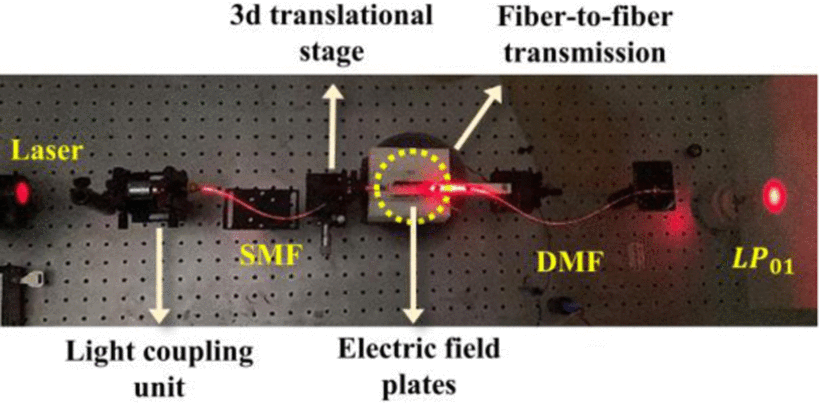
We focus on the development of fiber-optic sensors based on a fiber-cantilever deflection mechanism for electric and magnetic field sensing. We designed, fabricated, and optimized fiber- cantilever transducers using functional materials and integrated them into various advanced optical configurations, including Michelson interferometers, Sagnac loop interferometers, ring resonators, and Fabry–Perot interferometers, to enhance sensitivity and achieve lower detection limits. We also investigated mode propagation, selective mode excitation, and electric field-controlled mode switching in few-mode optical fibers, demonstrating their potential for mode-division multiplexing (MDM) and broadband optical communication applications.
Cladding-Mode Interference Sensors: Theoretical Modeling and Experimental Validation
This research focuses on optical fiber devices and fiber-optic sensing technologies. We develop and experimentally characterize cladding-mode interference-based fiber devices for high-sensitivity temperature and refractive-index sensing. By integrating theoretical analysis, numerical simulations, and experimental validation, the research has contributed to the development of high-performance fiber-optic sensors and photonic devices for advanced sensing and optical communication applications.

Optical Fiber-based Sensing
Our research focuses on the development of advanced fiber- optic sensing and photonic technologies for precision measurement and real-world applications. We design, develop, and experimentally validate a wide range of optical sensing systems, including fiber-optic sensors, fiber Bragg grating (FBG)-based sensors, polarization-based optical sensors, and a fiber-optic cantilever probe. These technologies are used to measure flow velocity, strain, temperature, Young's modulus, and liquid viscosity. Our research also explores specialty optical fibers and innovative sensing techniques to enhance the accuracy, sensitivity, and reliability of optical measurement systems. Our research integrates experimental investigations, theoretical analysis, and numerical simulations using MATLAB and COMSOL Multiphysics to design and optimize optical sensing systems for scientific, industrial, and engineering applications.

Metamaterials
Our research focuses on the design of advanced metamaterials and graphene-based metasurfaces for nonlinear THz photonics. We design, develop, and numerically validate novel metamaterial and graphene-based metasurface structures to enhance third-order nonlinear optical processes, including third-harmonic generation (THG) and four-wave mixing (FWM). By combining resonance engineering, plasmonic field confinement, and electromechanical tuning, our work demonstrates compact, reconfigurable, and high-performance THz devices based on complementary split-ring resonators, suspended graphene structures, graphene micro-cantilevers, and coupled graphene-ring metasurfaces. These studies provide new strategies for controlling nonlinear light-matter interactions and contribute to the development of next-generation THz sources, frequency converters, and integrated nonlinear photonic devices.

Nonlinear Fiber Optics
Our research focuses on experimental and computational photonics, nonlinear fiber optics, and ultrafast optical phenomena, with particular emphasis on understanding and controlling nonlinear pulse dynamics in highly nonlinear fibers. We investigate soliton interactions, Raman scattering, temporal interference, pulse-shape-dependent evolution, and dispersion engineering in materials. Our work combines analytical modeling, numerical simulations, and generalized nonlinear Schrödinger equation (GNLSE) based methods to study ultrashort-pulse propagation and nonlinear spectral-temporal dynamics. We have explored dispersion engineering for controlling soliton interactions and Raman-induced effects, as well as machine-learning approaches for nonlinear optical modeling, including physics-informed neural-network and nonlinear Schrödinger network frameworks. Overall, our research aims to develop new methods for controlling, modeling, and exploiting nonlinear optical phenomena for advanced photonic technologies.
